
If you've been following real estate news, you've probably heard that the housing market is "frozen." While home sales remain below historical averages, the reality is more nuanced. The slowdown isn't caused by a lack of buyers alone—it’s largely the result of homeowners choosing not to sell, creating an uneven market across the country.
Rather than a nationwide freeze, today's housing market is experiencing different conditions depending on location, inventory, and homeowner behavior.
Buyers Haven't Disappeared
Despite affordability challenges, demand for homeownership remains strong.
Many first-time buyers are still entering the market, and household formation continues at a relatively healthy pace. While some buyers delayed purchasing homes following the last housing downturn, that backlog has gradually narrowed over the years instead of continuing to grow.
Today's slower sales aren't simply because buyers have lost interest—they're facing limited choices and higher financing costs.
The Real Bottleneck Is the Lack of Homes for Sale
The biggest challenge facing today's housing market is on the supply side.
Millions of homeowners secured historically low mortgage rates during 2020 and 2021. Selling today often means replacing a mortgage below 3% with one above 6%, dramatically increasing monthly housing costs.
As a result, many homeowners are delaying moves they might otherwise make, including:
- Upsizing for a growing family
- Downsizing after retirement
- Relocating for work
- Purchasing investment properties
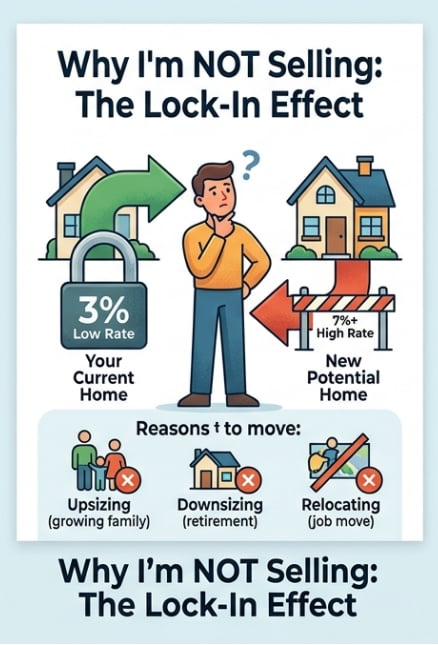
This "lock-in effect" has significantly reduced the number of homes entering the market, keeping inventory below normal levels.
Why Fewer Sellers Affect Everyone
Real estate is a chain reaction.
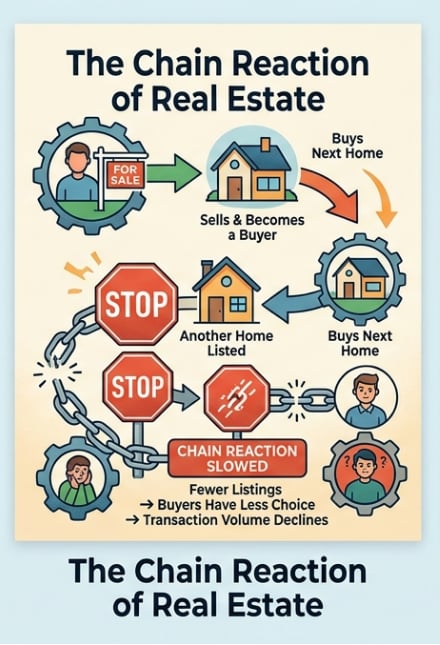
When one homeowner sells, they often become a buyer for another property. That creates opportunities throughout the market.
When fewer homeowners move:
- Fewer homes are listed.
- Buyers have fewer choices.
- Overall transaction volume declines.
- The market feels slower, even if demand remains steady.
This explains why some neighborhoods continue to experience multiple offers while others see listings remain on the market longer.
Local Markets Are Moving at Different Speeds
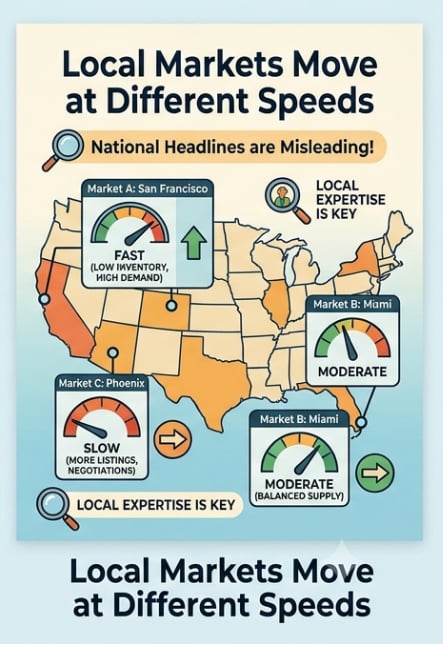
National headlines can be misleading because housing conditions vary significantly from one market to another.
Some areas continue to experience:
- Limited inventory
- Strong buyer demand
- Stable or rising prices
Meanwhile, other markets are seeing:
- More listings
- Longer selling times
- Increased price negotiations
For buyers and sellers, understanding local market conditions is far more valuable than relying solely on national statistics.
What Could Help Unlock the Market?
Many economists believe that a meaningful decline in mortgage rates could encourage more homeowners to sell.
Lower borrowing costs would reduce the financial penalty of giving up a low-rate mortgage, increasing housing inventory and creating more opportunities for buyers.
However, if mortgage rates remain elevated, housing turnover may continue below historical norms even if buyer demand stays healthy.
What This Means for Buyers and Sellers
For Buyers
- More inventory may take time to arrive.
- Being pre-approved remains a competitive advantage.
- Local market knowledge matters more than national headlines.
- Well-priced homes can still attract strong competition.
For Sellers
- Proper pricing is becoming increasingly important.
- Buyers are more selective than during the pandemic housing boom.
- Well-prepared homes continue to perform well despite slower overall sales.
Market Perspective
Today's housing market isn't frozen—it is adjusting.
Demand for homeownership remains, but historically low mortgage rates have discouraged many homeowners from selling, reducing inventory and slowing transactions. Until more existing homeowners decide to move, the market is likely to remain uneven, with some areas staying highly competitive while others gradually become more balanced.
The housing market may look different from one neighborhood to the next, making local expertise more valuable than ever.
Whether you're buying, selling, or investing, understanding your local market can help you make confident real estate decisions.
Contact June Chang at 917-657-5198 for personalized guidance and the latest local market insights.